• Car enthusiast? Join us on Cars Connected! iOS | Android | Desktop
  • Hint: Use a descriptive title for your new message
    If you're looking for help and want to draw people in who can assist you, use a descriptive subject title when posting your message. In other words, "I need help with my car" could be about anything and can easily be overlooked by people who can help. However, "I need help with my transmission" will draw interest from people who can help with a transmission specific issue. Be as descriptive as you can. Please also post in the appropriate forum. The "Lounge" is for introducing yourself. If you need help with your G70, please post in the G70 section - and so on... This message can be closed by clicking the X in the top right corner.

Premium or regular in 2.5T

HimalayenGreyonista

Registered Member
Joined
Dec 11, 2021
Messages
25
Reaction score
4
Points
3
Location
Canada
Genesis Model Year
2022
Genesis Model Type
Genesis GV80
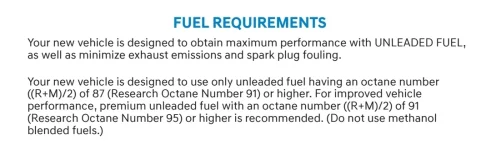
Picked up our GV80 last week. Haven’t yet put any fuel in, but the dealer indicated that although premium is recommended, you can use regular without issue. Wondering if anyone has tried both and notified any performance differences? What do you guys put in? Thx.
 
Looking to update and upgrade your Genesis luxury sport automobile? Look no further than right here in our own forum store - where orders are shipped immediately!
Congrats on the new car. It's all in the manual.

Screenshot_20211211-225318_Office Mobile.webp
 
Appreciate it. I’m more so looking to see if anyone noticed the performance difference between premium 87 and premium 91.
 
Appreciate it. I’m more so looking to see if anyone noticed the performance difference between premium 87 and premium 91.
Check out the other treads here about fuel. One post showed the HP drop on regular.

There are two sides. Those that don't notice much change, probably mild drivers around town where you don't get to utilize full performance.

Those that want all the performance you paid for. I paid $manythousnd and not going to cheap out on gas. .
 
Appreciate it. I’m more so looking to see if anyone noticed the performance difference between premium 87 and premium 91.
I bought GV80 2.5t in May 2021 I researched from many sources weather to use regular or premium gas for this magnificent vehicle!
I started with one tank of regular gas from dealer....emptied tank and refilled with Costco 93 octane and drove in city and interstate I noticed absolutely no change in power and possibley a minimal change in economy! I just got back from 600 mile trip with 14,000 on odometer using 87 octane and averaged over 27 mpg so I'm sold on regular with a huge savings at the pump! I have read this engines computer can adjust for octane fuel from 87 through 93! Hope this helps!
 
Your power or gas mileage will be effected very minimally using higher octane gas. You won't notice either. Don't believe me, Google it. You might find one thread that says so, but you will find 9 for each one that says it doesn't.

Octane effects other stuff, and not performance.

My last car said to use premium, no recommendation, use it. This car confuses me

I drive very little driving these days and I am not strapped for cash, so I have put premium in it so far. But if I had to drive a lot and with the price of gas today, I would probably use regular or mid grade as it is more than a few bucks more, to fill your tank. The engine warrantee for 100,000 miles and it is not a requirement to use premium so it is up to you.
 
Your power or gas mileage will be effected very minimally using higher octane gas. You won't notice either. Don't believe me, Google it. You might find one thread that says so, but you will find 9 for each one that says it doesn't.

Octane effects other stuff, and not performance.

My last car said to use premium, no recommendation, use it. This car confuses me

I drive very little driving these days and I am not strapped for cash, so I have put premium in it so far. But if I had to drive a lot and with the price of gas today, I would probably use regular or mid grade as it is more than a few bucks more, to fill your tank. The engine warrantee for 100,000 miles and it is not a requirement to use premium so it is up to you.
Up until the price of fuel jumping up a couple months ago,
I used nothing but premium. (She’ll, Chevron or Mobil). Use it not for the octane, but for the cleaners in the fuel. Now with the price so high, I’ve switched to regular. If/when price comes back down, I’ll switch back to premium with the extra cleaners.
 
The engine will make more power with 91 as the 2.5T does have a tune to take advantage of premium fuel, so if you want the highest performance, run 91.

If you don't care, then just run 87.
 
Any research I've read finds maybe 1-2% improvement in performance but the price can be 10% more. Also no evidence that Premium burns cleaner. Emissions tests on the same vehicle with regular vs premium showed no difference.

Seems like another crooked marketing scheme by large oil companies to me. Not that I'm paranoid, but I sure don't trust these organizations!
 
It's important to understand the difference between "regular" 87 and "premium" 91/93. Mid-grade is an at-the-pump mix of the two. I'm sure the oil companies chose those names to help promote sales.

Many people think higher octane fuel burns cleaner, make sure engine more powerful, or does other miraculous things. Octane slows the detonation rate, which is needed for high compression engines to reduce harmful engine knock (early detonation). However, engines have automatic adjustments to prevent the early detonation, so it's really down to a very small gain in performance which most people won't notice at all.

The most important thing you can do in choosing a fuel is to select a Top Tier fuel. They are proven to have the proper additives. Check it out -


Costco is my go-to, they are Top Tier, and CHEAP.
______________________________

Help support this site so it can continue supporting you!
 
It's important to understand the difference between "regular" 87 and "premium" 91/93. Mid-grade is an at-the-pump mix of the two. I'm sure the oil companies chose those names to help promote sales.

Many people think higher octane fuel burns cleaner, make sure engine more powerful, or does other miraculous things. Octane slows the detonation rate, which is needed for high compression engines to reduce harmful engine knock (early detonation). However, engines have automatic adjustments to prevent the early detonation, so it's really down to a very small gain in performance which most people won't notice at all.

The most important thing you can do in choosing a fuel is to select a Top Tier fuel. They are proven to have the proper additives. Check it out -


Costco is my go-to, they are Top Tier, and CHEAP.
Thanks for that. You share my thoughts exactly. Some cars must run on Premium and they will tell you so. In this car it is recommended, not mandatory. But since I don't drive much, I put in premium. If I was racking up the miles and tight for a buck, it would be regular. But most turbos like it hot.
It drives me nuts, when people think that putting premium in a car that only requires regular will make their car go faster and get better MPG. (And I don't mean a fraction of a percent)
 
When we went to put in our order for a 23 GV80 3.5T Prestige the salesman told us that using 93 which is what we have in NC would only have maybe 2HP difference. I'm going to use regular as it can use that without causing knock sensor issues. I bought my daughter a fully loaded Mazda CX-5 Signature trim last week and it's a 2.4T or 2.5T and it does have a pretty huge difference in power using 87 (227HP) or 93 (250HP). Took it on a 600-mile road trip and the first tank of gas was 93 which burnt very quickly compared to the 87 used on the way back. Sadly, these turbo vehicles are nowhere as fuel efficient as NA engines from what I am seeing.
 
When we went to put in our order for a 23 GV80 3.5T Prestige the salesman told us that using 93 which is what we have in NC would only have maybe 2HP difference. I'm going to use regular as it can use that without causing knock sensor issues. I bought my daughter a fully loaded Mazda CX-5 Signature trim last week and it's a 2.4T or 2.5T and it does have a pretty huge difference in power using 87 (227HP) or 93 (250HP). Took it on a 600-mile road trip and the first tank of gas was 93 which burnt very quickly compared to the 87 used on the way back. Sadly, these turbo vehicles are nowhere as fuel efficient as NA engines from what I am seeing.

93 would make zero difference over 91 as there is no fuel map for 93 in any stock GV80 tune. However, 91 will make more power than 87 as there is a fuel map in both the 2.5 and 3.5 for 91.

Also, the CX-5 has an 87 and 91 fuel map, but not a 93. The CX-5 makes about 30 more whp with 91 vs 87.

Some vehicles do have a 93 map, my 911 does.

Also, universally true - higher octane always results in lower fuel economy. However, you can see about 10% better fuel economy by running zero-ethanol fuel.
 
93 would make zero difference over 91 as there is no fuel map for 93 in any stock GV80 tune. However, 91 will make more power than 87 as there is a fuel map in both the 2.5 and 3.5 for 91.

Also, the CX-5 has an 87 and 91 fuel map, but not a 93. The CX-5 makes about 30 more whp with 91 vs 87.

Some vehicles do have a 93 map, my 911 does.

Also, universally true - higher octane always results in lower fuel economy. However, you can see about 10% better fuel economy by running zero-ethanol fuel.
I'm not sure how much of the USA has 93 fuel but it's all we have here and then there is 90 non-ethanol at select gas stations. I've seen 15 and 88 a few places as well. I made the mistake of trying 90 non-ethanol in my Infiniti and it almost blew the engine. 91 is the equivalent of 93 here so that's what we use in our German sedans.
 
Yeah, if you don't have 91 available and only have 93, then it would be a good idea to run 93 in that situation.

We didn't have anything higher than 91 (without ethanol) until very recently here. We always had 94 from Petro-Canada with 10% ethanol, but I won't run that garbage :)
 
93 would make zero difference over 91 as there is no fuel map for 93 in any stock GV80 tune. However, 91 will make more power than 87 as there is a fuel map in both the 2.5 and 3.5 for 91.

Also, the CX-5 has an 87 and 91 fuel map, but not a 93. The CX-5 makes about 30 more whp with 91 vs 87.

Some vehicles do have a 93 map, my 911 does.

Also, universally true - higher octane always results in lower fuel economy. However, you can see about 10% better fuel economy by running zero-ethanol fuel.
Where I have lived most of my life eastern USA, they have 3 grades. 87, 89, and 93. I have never seen 91 octane. Some oddball stations sell the 90 ethanol free (which I use in my generator and lawn tractor, and also some other weird stuff, but basically that is the three you get at any major gas station in the east USA. So for me, if a car recommended 91 octane, my only option was 93 premium and not mid grade 89.

Koala, I have read a lot of your posts and learned a lot from them. I know nothing about mapping and the such, but 95% of the articles I read about using different octanes, say the amount of horsepower and gas milang is negligible, less than 2% and when you throw in the price, your wasting your money if you don't need the higher octane. That being said, I put premium in mine as that is what they recommend. In a different time in my life when I drove a lot and did not have a lot money, I would be putting regular in this car.
I am not changlanging your post, you may be correct. You put a lot of thought and research information in this post that I know nothing about, but I can only say that when I do a google search about the effect of octane and mileage and performance, I get different information. (Also I don't drive a 😦 porsche)
Again, thank your for all the info I have gotten from you about my new whip.
 
Hi Jhon - there are really a few different components to this:
  1. Cost considerations - obviously, most people want to spend the lowest amount they need to
  2. Power considerations - higher octane = more power (provided there is a fuel map that can use the higher grade of fuel)
  3. Maintenance & longevity considerations - higher grade fuel typically has more detergents and such, and will help minimize deposits and build up
I would expect that if there was less than 2% power difference on a dyno, then that is effectively a 0% power difference (2% between dyno runs is statistically irrelevant), which would then lead me to believe that the specific vehicle they ran such tests on simply does not have an ECU which can effectively advance engine timing (as in, it doesn't have a fuel map for 91)

My own take on this is that the price difference between 87 and 91 is around 10%, but because 91 with zero ethanol returns about 10% better economy, it's approximately the same total cost in the end. The benefit is that you're making more power and taking (probably marginally) better care of your engine over the long run.

So yes, folks could run 87 on these vehicles and it's totally fine, but they're not really saving any real money in the end, at least if the price difference between 87 and 91 is 10% or less... and they're doing it at the expense of making less power. You're likely giving up about 30-35 whp on the 2.5T and 45-50 whp on the 3.5T.

The 2.5T puts down about 255 whp / 300 tq on a dynojet running 91.

The 3.5T puts down about 330 whp / 355 tq on a dynojet running 91.

Unfortunately, I couldn't find any dyno charts for these vehicles running 87 as I don't think anyone would be crazy enough to actually run the lower grade and slap it on a dyno :)

I think the best modern example of this is with Mazda. They have quite a few vehicles that are well documented and marketed directly by Mazda with both 87 and 91 power figures.
 
"Unfortunately, I couldn't find any dyno charts for these vehicles running 87 as I don't think anyone would be crazy enough to actually run the lower grade and slap it on a dyno :)"

I'd do it in a heartbeat if it would put an end to all this speculation and soapboxing here!
 
As Jhon stated most stations only have 87, 89 or 93 which is the norm here in Ohio. I know people mix half 89 with half 93 and that comes out ot 91 which is "recommended". I think I'm going to just go with 89 as my minimum and use 93 when I'm only down about a half tank. If I mix the two I have to shut off the pump and restart so I lose my Shell discount
 
Last edited:
As Jhon stated most stations only have 87, 89 or 91 which is the norm here in Ohio. I know people mix half 89 with half 93 and that comes out ot 91 which is "recommended". I think I'm going to just go with 89 as my minimum and use 93 when I'm only down about a half tank. If I mix the two I have to shut off the pump and restart so I lose my Shell discount
You don't have to do that. Just use the highest grade gas for your area. It won't harm your vehicle. We have 93 in NC so that's what I use. I don't think it will make much of a difference if you run 91 as it's the highest Octane in Ohio. If it were a problem dealerships that sell German cars would probably be out of business if they couldn't sell those high Octane only vehicles.
 
Back
Top