• Car enthusiast? Join us on Cars Connected! iOS | Android | Desktop
  • Hint: Use a descriptive title for your new message
    If you're looking for help and want to draw people in who can assist you, use a descriptive subject title when posting your message. In other words, "I need help with my car" could be about anything and can easily be overlooked by people who can help. However, "I need help with my transmission" will draw interest from people who can help with a transmission specific issue. Be as descriptive as you can. Please also post in the appropriate forum. The "Lounge" is for introducing yourself. If you need help with your G70, please post in the G70 section - and so on... This message can be closed by clicking the X in the top right corner.

Caliper Bleeding Info

Fumes

New member
Joined
Jul 11, 2020
Messages
11
Reaction score
10
Points
3
Genesis Model Type
Genesis G90
I wanted to see if anyone dabbled in this area. This weekend I had my new rims off to upgrade my Rotors and Pads on the G90. In the process of doing that I decided to paint my calipers (which looks awesome on the G90 BTW). With that I need to now bleed the brake system out which should not be too bad as minimal air was induced into the system. I went to my local Genesis Dealer prior to doing this to acquire the proper brake fluid used etc. I just need to know if I need to crack both bleeder screws on the calipers (one at a time) to do the bleed or can it be done by doing just one of them? I looked through here seeing anyone had posted something prior but could not find anything. I know most of us would have our brakes done by the dealer, but in this case I did them myself, actually one of the easier brake systems to work on. The front calipers look very similar to Brembo style setup, so I am assuming you have to do both bleeders, but looking for to hearing any feedback.

Thank you for any input.
 
Last edited:
I wanted to see if anyone dabbled in this area. This weekend I had my new rims off to upgrade my Rotors and Pads on the G90. In the process of doing that I decided to paint my calipers (which looks awesome on the G90 BTW). With that I need to now bleed the brake system out which should not be too bad as minimal air was induced into the system. I went to my local Genesis Dealer prior to doing this to acquire the proper brake fluid used etc. I just need to know if I need to crack both bleeder screws on the calipers (one at a time) to do the bleed or can it be done by doing just one of them? I looked through here seeing anyone had posted something prior but could not find anything. I know most of us would have our brakes done by the dealer, but in this case I did them myself, actually one of the easier brake systems to work on. The front calipers look very similar to Brembo style setup, so I am assuming you have to do both bleeders, but looking for to hearing any feedback.

Thank you for any input.
Curious how you ended up bleeding the calipers. I believe both bleeders need to be done but not sure which one to do first (inboard or outboard bleeder). Could you share your experience and result?
 
The service manual points to both bleeders and does not say which one to do first. I think that in general, you are supposed to bleed the inside one first (closest to the brake hose), then the outside one.
 
You always bleed the furthest from the master cylinder first. I.e. the passenger side rear outer, then the inner, then driver side rear outer then inner,......continuining around till you end up at the driver side front.
 
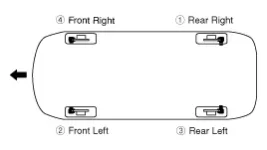
The ABS unit is on the right (passenger) side of the car though. The brake lines don't run straight to the master cylinder, they run to the ABS unit, then to the master cylinder. The service manual does mention a wheel order, right rear, front left, rear left, and then front right. I suspect that this order has to do with the internal plumbing on the ABS. Personally, I'd go by the service manual for the specific car, rather than the way it always worked in the 70s.

If you bleed the outside first, then air from the inside one may still get to the outside, since fluid movement is from the inside to the outside. Of course, I don't have personal experience with calipers with pistons on both sides, but those that do, say to do the inside first, then the outside.

1643825588531.webp
 
The ABS unit is on the right (passenger) side of the car though. The brake lines don't run straight to the master cylinder, they run to the ABS unit, then to the master cylinder. The service manual does mention a wheel order, right rear, front left, rear left, and then front right. I suspect that this order has to do with the internal plumbing on the ABS. Personally, I'd go by the service manual for the specific car, rather than the way it always worked in the 70s.

If you bleed the outside first, then air from the inside one may still get to the outside, since fluid movement is from the inside to the outside. Of course, I don't have personal experience with calipers with pistons on both sides, but those that do, say to do the inside first, then the outside.
I’ve been trying to locate the ABS unit in my G90 (V8) but never saw it. Exactly where is it? It’s certainly not visible from the top of the engine compartment. I’ve removed the belly pan but did not see it from the bottom of the engine either.
 
I think you have to remove the jump start stuff to be able to see it below there.
 
The ABS unit is on the right (passenger) side of the car though. The brake lines don't run straight to the master cylinder, they run to the ABS unit, then to the master cylinder. The service manual does mention a wheel order, right rear, front left, rear left, and then front right. I suspect that this order has to do with the internal plumbing on the ABS. Personally, I'd go by the service manual for the specific car, rather than the way it always worked in the 70s.

If you bleed the outside first, then air from the inside one may still get to the outside, since fluid movement is from the inside to the outside. Of course, I don't have personal experience with calipers with pistons on both sides, but those that do, say to do the inside first, then the outside.

View attachment 43122
Furthest first will always work. If the fluid flow is from inside to outside, my method is still bleeding the furthest first and will work great.
 
Last edited:
Looking to update and upgrade your Genesis luxury sport automobile? Look no further than right here in our own forum store - where orders are shipped immediately!
Furthest first will always work. If the fluid flow is from inside to outside, my method will still work.
And you are sure of which line is the furthest? Anyway, no problem. You do as you please. Being an engineer, I'll stick to what the engineer's who designed it recommend.
 
The ABS unit is on the right (passenger) side of the car though. The brake lines don't run straight to the master cylinder, they run to the ABS unit, then to the master cylinder. The service manual does mention a wheel order, right rear, front left, rear left, and then front right. I suspect that this order has to do with the internal plumbing on the ABS. Personally, I'd go by the service manual for the specific car, rather than the way it always worked in the 70s.

If you bleed the outside first, then air from the inside one may still get to the outside, since fluid movement is from the inside to the outside. Of course, I don't have personal experience with calipers with pistons on both sides, but those that do, say to do the inside first, then the outside.

View attachment 43122
Furthest first will always work. If the fluid flow is from inside to outside, my method will still work.
And you are sure of which line is the furthest? Anyway, no problem. You do as you please. Being an engineer, I'll stick to what the engineer's who designed it recommend.
Not sure what a profession has to do with it, hell, I am a scientist. I fix engineers cars all the time. Furthest first will work.
______________________________

Help support this site so it can continue supporting you!
 
Furthest first will always work. If the fluid flow is from inside to outside, my method will still work.

Not sure what a profession has to do with it, hell, I am a scientist. I fix engineers cars all the time. Furthest first will work.
Mev: I was replacing rotors/pads when I ran into a parking brake problem. What a pain parking brakes are to rebuild!
Anyway....about to do the bleed. I have always heard to bleed furthest away also until I ran into the manual and the odd RR, FL, RL, FR order.

Question....did you follow the odd manual order and how did it work out? Did you just do a manual bleed with somebody helping you pump the brake....or did you use a pump tool?

I started with the RL using a manual pump and just kept sucking air forever..... so maybe old school is not the way to go; and, starting with the RR is the correct method.
Any assistance is helpful.
 
The ABS unit is on the right (passenger) side of the car though. The brake lines don't run straight to the master cylinder, they run to the ABS unit, then to the master cylinder. The service manual does mention a wheel order, right rear, front left, rear left, and then front right. I suspect that this order has to do with the internal plumbing on the ABS. Personally, I'd go by the service manual for the specific car, rather than the way it always worked in the 70s.

If you bleed the outside first, then air from the inside one may still get to the outside, since fluid movement is from the inside to the outside. Of course, I don't have personal experience with calipers with pistons on both sides, but those that do, say to do the inside first, then the outside.

View attachment 43122
Joegr: Mind me asking if you actually tried this manual order? I'm about to do a 2015 5.0.
 
Joegr: Mind me asking if you actually tried this manual order? I'm about to do a 2015 5.0.
No, haven't had to yet.
 
Mev: I was replacing rotors/pads when I ran into a parking brake problem. What a pain parking brakes are to rebuild!
Anyway....about to do the bleed. I have always heard to bleed furthest away also until I ran into the manual and the odd RR, FL, RL, FR order.

Question....did you follow the odd manual order and how did it work out? Did you just do a manual bleed with somebody helping you pump the brake....or did you use a pump tool?

I started with the RL using a manual pump and just kept sucking air forever..... so maybe old school is not the way to go; and, starting with the RR is the correct method.
Any assistance is helpful.
I always use an assistant to pump and hold the pedal down. I have not had to bleed the brakes on my G90 yet, but the furthest away method will work. If the service manual has a different method i would do that, but i have not been able to locate a factory service manual for the G90.
 
In general, starting with the farthest is preferred, but I wouldn't obsess over the exact order too much. Brake Fluid is cheap, so as long as you bleed each corner thoroughly, you're fine.

Besides, unless you have a software tool to open up the right solenoid valves in the ABS pump/controller, there will always be some volume of old fluid trapped in there. Some motorcycle OBDII tools have brake bleed mode that you can activate to help clean that out. I'm not aware of any automotive equivalent. They probably do exist, but the consequence of not doing that is likely not very consequential, just like bleeding the 4 corners somewhat "out-of-order".

Realistically, most motorists don't even know the brake fluid needs to be changed periodically. The fact that you're doing it makes you so much better off than most others on the road already.

As for the method of bleeding... I've tried the mitivac pump once or twice, but never bothered with it since. Manually just works. On a motorcycle, it's easy to do it 1 man. With a car, you do need a helper to press/release the pedal on command. I've had my son help me with it when he was as young as 11-12yo. It's pretty easy and straightforward.
 
In general, starting with the farthest is preferred, but I wouldn't obsess over the exact order too much. Brake Fluid is cheap, so as long as you bleed each corner thoroughly, you're fine.

Besides, unless you have a software tool to open up the right solenoid valves in the ABS pump/controller, there will always be some volume of old fluid trapped in there. Some motorcycle OBDII tools have brake bleed mode that you can activate to help clean that out. I'm not aware of any automotive equivalent. They probably do exist, but the consequence of not doing that is likely not very consequential, just like bleeding the 4 corners somewhat "out-of-order".

Realistically, most motorists don't even know the brake fluid needs to be changed periodically. The fact that you're doing it makes you so much better off than most others on the road already.

As for the method of bleeding... I've tried the mitivac pump once or twice, but never bothered with it since. Manually just works. On a motorcycle, it's easy to do it 1 man. With a car, you do need a helper to press/release the pedal on command. I've had my son help me with it when he was as young as 11-12yo. It's pretty easy and straightforward.
I have the mitivac pump and love it. It’s a one man operation and easy to just pull fluid thru the system to the bleeder hose and wait for it to get clear. Just need to be sure you don’t suck the reservoir too low before adding fluid. Have not used it on my G70 for it’s too new to need to worry about brakes yet. On my Harley I could still see fluid level while I’ll pulled fluid thru so it was a snap.
 
When you have multiple bleeder valves on Hyundai Genesis/Equus.

It is outside first then inside. You guys are putting up wrong info.
 
The reason for the cross bleeding is simple. That is the design of the ABS module. The master cylinder has two lines that feed the ABS distribution block. One line feeds the solenoids for the RR & FL and the second line feeds the RL & FR. Since you are operating the master cylinder to push fluid, you want to eliminate air from the shared line feed before doing the second shared line feed. That reduces the likelihood of air being re-fed into a line you just bled if you have air trapped in the shared front lines. Sure, you can keep re-bleeding until all air is out, but there is a logical reason to the cross bleeding.
 
The reason for the cross bleeding is simple. That is the design of the ABS module. The master cylinder has two lines that feed the ABS distribution block. One line feeds the solenoids for the RR & FL and the second line feeds the RL & FR. Since you are operating the master cylinder to push fluid, you want to eliminate air from the shared line feed before doing the second shared line feed. That reduces the likelihood of air being re-fed into a line you just bled if you have air trapped in the shared front lines. Sure, you can keep re-bleeding until all air is out, but there is a logical reason to the cross bleeding.
As long as you bleed all the nipples one after another in the same session, it really doesn't matter. You are going to flush all the old fluid out of the system one way or another.

Just the fact that you are actually flushing your brake fluid means you're doing far better than the vast majority of car owners, who don't even know changing brake fluid is a thing.
 
Back
Top