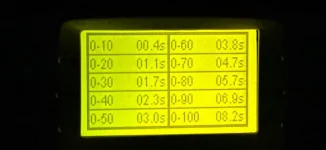
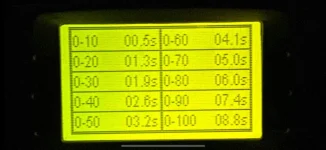
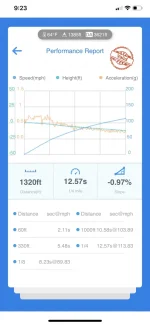
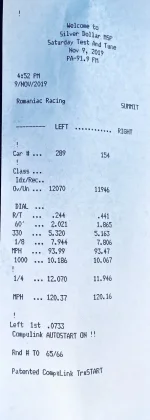
Yep I usally am sitting around 5500-6000 so I can only imagine what I could do at 400.
borrowed this from another forum.
“
There has to be a “Standard Reference” (SAE J2723) when determining the Rated HP of a given vehicle. And this is done by operating the vehicle in a “Standard Environmental Condition”.
Ideally, a Standard Environmental Condition (“Standard Day”), and would be:
1. Sea level
2. A barometer of 29.92” Hg.
3. An ambient air temperature of 59 degrees F (+15 C)
4. A relative humidity of 0%
This meteorlogical condition is the basis of determining rated SAE HP. It is also the standard condition for determining 1/4 mile acceleration performance.
Just because a track is at an elevation close to sea level, the
Density Altitude (DA) of a given track may be real high due to a local environmental condition of low barometric pressure, high temperature and/or high humidity at the time … So, we can say that; Density Altitude (DA) is the
actual altitude of the track adjusted for the
barometric pressure and
relative humidity at the time.
Then combine a high PA with a high ambient air temperature, and you get a very high
Density Altitude (DA) … Density Altitude is the actual track altitude above sea level, adjusted for the barometric pressure, ambient air temperature and relative humidity.
And a high DA is what kills horsepower and results in high ETs and low trap speeds.
On the other hand, operating a vehicle on a track close to sea level, at very cold track temperature, a condition of high barometric pressure and very low humidity would result in faster 1/4 mile times than when operated at a Sea Level / Standard Day track, and would also not be an accurate measurment of the car’s rated HP.
Without a “standard condition reference”, there is no way to determine whether or not a certain modification has made an improvement or not in regard to power output … So, you need to make an adjustment in the ET and Trap Speed for the variation in Density Altitude on that given day and time.